
SMARTHEART®
Human 3D Cardiac microtissue platform
SmartHeart® is a 96-well platform for drug efficacy testing, cardiotoxicity assessment and cardiac disease modeling. Human iPSC-derived cardiomyocytes and cardiac fibroblasts self-assemble around a central pillar into nine ring-shaped 3D cardiac microtissues per well. The circular geometry maintains the tissues under mechanical load and enables multiple tissue-level measurements of contractility, electrical activity and calcium dynamics within each experimental condition.
Human 3D Cardiac Safety Assessment
Go beyond ion-channel screening
Human 3D Cardiac Efficacy & Rescue
Capture the integrated cardiac response

RING-SHAPED HUMAN ENGINEERED HEART TISSUES (EHTs)
Connecting tissue architecture, mechanical load and cardiac function
SmartHeart® combines human iPSC-derived cardiomyocytes and cardiac fibroblasts in self-assembling, ring-shaped tissues around a central pillar. This architecture guides tissue organization and provides mechanical resistance during contraction.
Tissue organization, mechanical loading and cellular maturation are closely linked to cardiac function. SmartHeart® brings these elements together in a 3D model, enabling researchers to investigate electrical activity, calcium dynamics and contraction within the same tissue platform.

3-IN-1 CARDIAC ASSAY: CONTRACTILITY,
ELECTROPHYSIOLOGY AND CALCIUM DYNAMICS
SmartHeart® measures three interconnected components of cardiac function: electrical excitation, intracellular calcium dynamics and mechanical contraction. Together, these readouts help characterize how compounds affect excitation–contraction coupling in human 3D cardiac microtissues.
CONTRACTILITY

Contractility Metrics
-
Frequency
-
Contraction stress
-
Contraction strain
-
Contraction speed
-
Relaxation speed
Cardiac functional effects
-
Chronotropic effects
-
Inotropic effects
-
Contractile kinetics
-
Lusitropic effects
ELECTROPHYSIOLOGY

Action potential Metrics
-
Frequency
-
Interpeak duration STD Rising time, Upstroke velocity
-
APD10-90
-
Triangulation, Plateau phase
Electrophysiology features
-
Rhythm
-
Regularity Depolarization
-
Impacted ion channels
-
Proarrhythmia
CALCIUM TRANSIENTS

CaT Metrics
-
Frequency
-
Interpeak duration STD Amplitude
-
Area Under curve ‘Rise and decay’ duration and speeds
-
CD10,50,90
Comprehensive understanding of calcium dynamics in tissues
Frequency supports chronotropic assessment; contraction stress and strain characterize inotropic effects, while contraction and relaxation speeds describe contractile and lusitropic kinetics.


Brightfield - Contractility

FluoVolt - membrane action potential

CAL520 - Calcium transient
SMARTHEART® PLATFORM SPECIFICATIONS

HUMAN CARDIAC CELL COMPOSITION
Human iPSC-derived cardiomyocytes and cardiac fibroblasts

96-WELL PLATE FORMAT
Designed for scalable cardiac studies

MULTIPARAMETRIC FUNCTIONAL ASSESSMENT
Contractility, electrophysiology, and calcium dynamics

SELF-ASSEMBLING TISSUES
Cells self-assemble into ring-shaped 3D cardiac microtissues after seeding

LOW CELL REQUIREMENT
7,200 cells per tissue, with a 3:1 cardiomyocyte-to-fibroblast ratio

9 MICROTISSUES PER WELL
Within-well assessment of tissue response consistency

HIGH-RESOLUTION IMAGING
Glass bottom plate

IN SITU CHARACTERIZATION
Direct functional measurements in the culture plate, without transferring the microtissues
SMARTHEART® TISSUE STRUCTURE AND FUNCTION
SmartHeart® combines ring-shaped 3D tissue architecture with structural, molecular and functional characterization. Fluorescence imaging and immunostaining reveal tissue organization and sarcomeric structures, RT-qPCR profiles cardiac gene expression, and functional assays quantify responses to reference compounds. Together, these complementary readouts provide a powerful human 3D cardiac model for investigating cardiac function and drug-induced effects.
RING-SHAPED 3D TISSUE ARCHITECTURE
SmartHeart® microtissues form a continuous ring around a central deformable pillar. This geometry generates radial mechanical loading during contraction and enables tissue-level measurements of contraction strain and stress.

3D reconstruction of a SmartHeart® microtissue. Vimentin (green), cardiac troponin T (red) and nuclei (DAPI, blue)
ORGANIZED CONTRACTILE FIBERS AND SARCOMERES
Cardiac troponin T immunostaining shows organized contractile fibers and sarcomeric structures within the 3D microtissues.

Cardiac troponin T (red) and nuclei (DAPI, blue), imaged at 63× magnification – Seguret & al.
Published imaging configuration
The fluorescence images shown above were generated using the ring-shaped cardiac tissue configuration described by Seguret et al. in eLife, combining human iPSC-derived cardiomyocytes and normal adult human dermal fibroblasts at a 3:1 ratio. The current SmartHeart® platform retains the ring-shaped, pillar-based architecture and uses cardiac fibroblasts.
CARDIAC GENE EXPRESSION
RT-qPCR data highlight the upregulation of key genes for cardiac function compared to 2D models.

RT-qPCR analysis was performed at days 15–16. Gene expression was normalized to GAPDH and calculated using the 2^−ΔΔCq method, with matched 2D cultures used as the calibrator. For each gene, N = 3 independent experiments; each experiment included 15–36 cardiac rings.
TISSUE-LEVEL CONTRACTILITY BEYOND ION-CHANNEL AND MOTION-BASED ASSAYS
Conventional hERG and CHO assays assess ion-channel activity, while standard 2D hiPSC-CM assays commonly infer contractile performance from cellular motion, shortening or impedance. SmartHeart® quantifies the deformation of a calibrated central pillar by mechanically loaded human 3D cardiac microtissues, providing tissue-level measurements of contraction strain, contraction and relaxation kinetics and, where pillar calibration is available, derived contractile stress.
The examples below illustrate positive and negative inotropic responses to reference compounds with distinct mechanisms of action.
Positive inotropic responses
Positive-inotrope data were acquired at day 21 in low-Ca²⁺ Tyrode solution under spontaneous beating conditions. Contractile parameters were quantified from brightfield videos.
Negative inotropic responses
The examples below are drawn from the SmartHeart® cardiac-safety dataset. Experimental conditions and sample sizes are reported in the associated white paper.
Isoprenaline
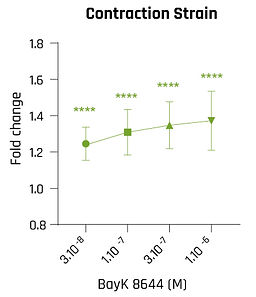
BayK 8644
Metoprolol


β-adrenergic stimulation increased beating frequency, contraction strain and contraction and relaxation speeds (N = 2; n = 16).
In this exploratory dataset, L-type Ca²⁺ channel activation increased contraction strain and contraction speed while reducing spontaneous beating frequency (N = 1; n = 11).
β1-adrenergic blockade reduced beating frequency and contraction stress in the cardiac-safety dataset (N = 2; n = 25 tissues for contractility).
Omecamtiv Mecarbil

Cardiac myosin activation increased contraction strain with little change in beating frequency and non-monotonic changes in contraction speed (N = 1; n = 10).
Istaroxime

Istaroxime increased contraction strain and both contraction and relaxation speeds, producing a luso-inotropic profile in this dataset (N = 1; n = 10).
Nifedipine

L-type Ca²⁺ channel blockade reduced contractile readouts and altered action-potential and calcium-transient parameters in the cardiac-safety dataset.
SMARTHEART®
CONTRACTILITY ASSAY - PERFORMANCE & QUALIFICATION
The SmartHeart Contractility Assay has undergone fit-for-purpose qualification for detecting and characterizing drug-induced inotropic effects in human 3D cardiac microtissues.
The qualification study evaluated seven reference compounds with distinct pharmacological mechanisms, assessing the accuracy of inotropic response detection, concentration-response relationships, assay reproducibility and analytical sensitivity.
Under the qualified experimental conditions, SmartHeart correctly identified the direction of inotropic effects for all seven reference compounds.
7/7
Correct inotropic effect detection
3
Independent experiments per compound
>20
Evaluable tissues per compound
3.7-5.7%
Minimum detectable effect by readout
Performance characterized using at least 20 evaluable cardiac rings per compound across three independent experiments. Minimum Detectable Effect values refer to the qualified study design and selected contractility readouts.
PHARMACOLOGICAL QUALIFICATION USING SEVEN REFERENCE COMPOUNDS
The assay was evaluated with five positive and two negative inotropic reference compounds targeting different components of cardiac contraction, including adrenergic receptors, calcium channels, cardiac myosin and ion transport pathways.
SmartHeart detected the expected direction of the inotropic response for all seven compounds. Concentration-response analysis enabled the estimation of EC50 or IC50 values, which were compared with available published experimental data.
These results support the use of SmartHeart for characterizing drug-induced changes in cardiac contractility within the qualified assay conditions.
Reference compound
Isoproterenol
Bay K 8644
Omecamtiv mecarbil
Istaroxime
Phenylephrine
Itraconazole
Quinidine
Inotropic effect
Positive
Positive
Positive
Positive
Positive
Negative
Negative
SmartHeart EC50/IC50
35.7 nM
24.7 nM
519 nM
161 nM
0.569 µm
914 nM
1.31 µM
Positive inotropes

Negative inotropes

Concentration-response profiles of five positive and two negative inotropic reference compounds measured using SmartHeart. Contraction strain responses were normalized to vehicle baseline and evaluated across three independent experiments per compound. Curves show mean responses, variability and statistical significance.
ASSAY SENSITIVITY AND REPRODUCIBILITY
The SmartHeart qualification study quantified assay sensitivity through the Minimum Detectable Effect (MDE), accounting for tissue-to-tissue and experiment-to-experiment variability.
Under the qualified study design, the MDE ranged from 3.7% to 5.7% depending on the contractility readout. These values represent the smallest changes estimated to be reliably detectable with 80% statistical power at a 5% significance level, assuming an effect across approximately half of the tested concentration levels.
Reproducibility was evaluated using isoproterenol as a reference compound. After normalization to each tissue's vehicle baseline, batch-to-batch coefficients of variation remained below 10% for beating frequency and contraction strain across the four tested concentrations.
Readout
Beating frequency
Contraction strain
Mean contraction speed
Mean relaxation speed
MDE
3.7%
5.5%
4.5%
5.7%
MDE values were estimated from the reference compound panel using a minimum of 20 evaluable tissues per compound across three independent experiments. These estimates are specific to the qualified assay design and are not universal detection thresholds for individual tissues or alternative experimental conditions.
QUALIFIED ASSAY CONDITIONS AND SCOPE
The reported performance applies to SmartHeart tissues composed of human iPSC-derived cardiomyocytes and primary human ventricular fibroblasts at a 3:1 ratio, evaluated at Day 21 using acute sequential compound addition and brightfield video-based analysis.
The qualified assay measures cardiac tissue deformation (contraction strain), beating frequency and contraction/relaxation kinetics. It does not directly measure action potential duration or intracellular calcium transients.
Complementary electrophysiology, calcium-handling measurements, electrical pacing and longer exposure protocols can be incorporated according to the study objectives. These applications are distinct from the qualified core contractility workflow and may require additional characterization or qualification.
The interpretation of results depends on the tested concentration range, exposure conditions and readout-specific detection limits.
CARDIAC SAFETY ASSESSMENT
WITH CiPA REFERENCE COMPOUNDS
SmartHeart® was evaluated using seven CiPA reference compounds spanning high, intermediate and low torsade de pointes (TdP) risk categories.
By combining optical action-potential mapping with tissue-level contractility measurements, the platform captures compound-specific changes in repolarization, beating regularity and mechanical function.
These complementary readouts support an integrated, mechanistic assessment of proarrhythmic and cardiotoxic effects beyond ion-channel screening alone.
Selected HIGH TdP-RISK reference compounds


Selected LOW TdP-RISK reference compounds
See the cardiac-safety white paper for compound concentrations, experimental conditions, sample sizes and statistical analyses.
PACE X WELL-BY-WELL ELECTRICAL STIMULATION
PACE X provides independent electrical field stimulation in each well of a SmartHeart® plate. It supports rate-controlled functional measurements, well-by-well experimental protocols and repeated electrical conditioning of human 3D cardiac microtissues.

Unpaced

1.5 Hz

2 Hz

2.5 Hz
Controlled pacing frequency
Apply defined pacing frequencies to compare spontaneous and paced cardiac activity under standardized conditions. Different frequencies can be assigned across the plate to evaluate compounds, cell sources or culture protocols.
Reduced frequency-related variability
Spontaneous beating rate can influence contractility, action-potential and calcium-transient measurements. By imposing a defined rate, PACE X helps reduce frequency-related variability and improve the comparability of functional responses across experimental conditions.
Synchronized functional measurements
Perform optical measurements under controlled pacing conditions to investigate rate-dependent changes in contraction, action potential and calcium dynamics.
Electrical conditioning for cardiac tissue maturation
Repeated electrical pacing can promote structural and functional maturation of hiPSC-derived cardiac tissues. PACE X enables controlled conditioning protocols for SmartHeart® microtissues.
Selected studies on electrical pacing and cardiac tissue maturation
Nunes et al. — Biowire: a platform for maturation of human pluripotent stem cell-derived cardiomyocytes. Nature Methods, 2013.
Ronaldson-Bouchard et al. — Advanced maturation of human cardiac tissue grown from pluripotent stem cells. Nature, 2018.
Physiological calcium combined with electrical pacing accelerates maturation of human engineered heart tissue. Stem Cell Reports, 2022.
SMARTX 3.0 DEEP-LEARNING ANALYSIS
SmartX 3.0 is an AI-powered image-analysis software designed to quantify the contractile function of SmartHeart® microtissues from brightfield videos.
Its deep-learning algorithm detects the cardiac microtissue and tracks deformation of the central pillar over time. It automatically extracts beating frequency, rhythm regularity, contraction strain, contraction and relaxation speeds and, where pillar calibration is available, derived contraction stress.


Analysis that improves with each session
SmartX 3.0 learns from each analysis session, progressively refining its ability to detect and track cardiac microtissues across variations in tissue morphology, image contrast and acquisition conditions. This adaptive workflow reduces manual analysis and supports robust, scalable contractility assessment across experiments.
Recommended input: brightfield videos of at least 500 × 500 pixels, recorded at a minimum of 35 frames per second for at least 10 seconds.
How SmartX calculates mechanical parameters
SmartX 3.0 quantifies tissue contraction by tracking deformation of the central pillar in brightfield videos. Contraction strain is calculated as the ratio of pillar deformation to the pillar’s maximum radius and is reported as a dimensionless normalized value (A.U.). Contraction and relaxation speeds represent changes in strain over time and are expressed in A.U./s. Contractile stress is derived by multiplying contraction strain by the Young’s modulus of the pillar, measured during plate production, and is reported in mN/mm².
ACCESS SMARTHEART THROUGH A TAILORED CARDIAC STUDY
Use SmartHeart® in your laboratory or work with 4Dcell scientists to design and perform a study tailored to your research question. Our cardiac testing services combine contractility, electrophysiology and calcium-transient measurements for drug efficacy, cardiotoxicity and mechanistic investigations.