
SMARTCONFINEMENT®
Cell Confinement for Mechanobiology
Study migration, nuclear mechanics and mechanotransduction under controlled mechanical confinement.

SmartConfinement® is a range of static and dynamic cell confinement devices developed by 4Dcell to control the vertical space available to cells between two parallel surfaces.
By imposing defined geometrical constraints, SmartConfinement enables researchers to investigate how physical confinement influences cell morphology, migration, nuclear deformation and cell division, while maintaining compatibility with optical microscopy.
HOW DOES CELL CONFINEMENT TECHNOLOGY WORK?
SmartConfinement controls cell height by positioning cells between a culture surface and an upper glass surface equipped with precisely defined PDMS micropillars. These micropillars act as spacers, establishing a controlled confinement height.
The technology allows researchers to study cellular responses to defined spatial constraints while retaining optical access to the confined cells.
Key features
-
Defined confinement height: Standard confinement slides are available with micropillar heights from 1 to 20 µm.
-
Static or dynamic confinement: Select a mechanically controlled static device or a pressure-controlled dynamic system, depending on the experiment.
-
Optical microscopy compatibility: Transparent components support imaging of cells under confinement, subject to the microscope configuration.
-
Experimental flexibility: Confinement can be combined with selected adhesive or non-adhesive surface treatments.
-
Cell recovery: Confinement can be released to enable subsequent cellular or biochemical analysis, depending on the protocol.
Custom configurations can be discussed with the 4Dcell team.


Easy to use
High resolution imaging
Long term cell culture
STATIC VS DYNAMIC CELL CONFINEMENT:
WHICH APPROACH SHOULD YOU CHOOSE?
SmartConfinement offers two complementary approaches to mechanical cell confinement, depending on whether the experiment requires a fixed confinement setup or controlled application and release.
Static cell confinement
Static confiners use a mechanical positioning system to establish a defined confinement height. They are suitable for experiments investigating cellular responses under maintained spatial constraints, including cell morphology, migration and nuclear mechanics.
4Dcell offers static confiners compatible with 35 mm glass-bottom dishes (CSOW 110) and glass-bottom 6-well plates (CSOW 620).
Dynamic cell confinement
The dynamic confiner uses a pressure-controlled system connected to a PDMS piston to apply and release confinement. This approach is particularly relevant for live-cell imaging experiments investigating cellular responses during mechanical confinement and after its release.
The selected micropillar geometry defines the nominal confinement height, while the pressure-control system enables dynamic operation.
RESEARCH APPLICATIONS OF CELL CONFINEMENT
Mechanical confinement influences multiple cellular processes, from migration and nuclear deformation to cell division and intracellular organization. SmartConfinement provides a controlled experimental environment for investigating these responses through microscopy and complementary biological assays.
Cell migration and cancer invasion
Investigate how spatial constraints affect cell migration, morphological transitions and movement through confined environments. Confinement experiments can help researchers study migration mechanisms relevant to cancer invasion and tissue microenvironments.
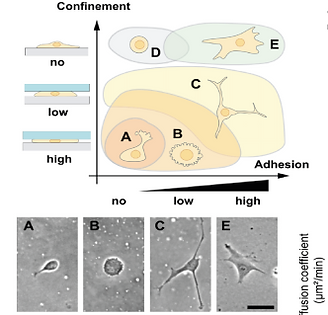
Cell migration behavior under different confinement and adhesion conditions
Illustration of how confinement height and cell-substrate adhesion conditions can influence cell migration phenotypes.

Confinement-dependent changes in cell phenotype
Illustration of cellular phenotypic transitions associated with variations in mechanical confinement height.
Nuclear mechanics and mechanotransduction
Study nuclear deformation, nuclear envelope integrity and cellular responses to mechanical constraints. Controlled confinement enables the investigation of how cell and nuclear geometry influence mechanotransduction and intracellular organization.

Nuclear deformation in HeLa cells under different confinement heights
Microscopy images comparing unconfined HeLa cells with cells mechanically confined at heights of 5 µm and 3 µm, illustrating confinement-dependent changes in nuclear morphology.
Cell division under mechanical confinement
Observe cells undergoing mitosis under defined spatial constraints. SmartConfinement can support studies of cell rounding, nuclear deformation, chromosome organization and cell division in mechanically restricted environments.
Video of cells dividing under confinement using a 4Dcell confiner
Live-cell imaging and intracellular dynamics
Optically accessible confinement systems enable imaging of cellular and subcellular structures under controlled geometrical constraints. Depending on the experimental setup, researchers can investigate organelle positioning, cytoskeletal organization and morphological changes in confined cells.
Live-cell imaging of HeLa cells under mechanical confinement
Time-lapse microscopy showing HeLa cells during the progressive application of mechanical confinement using SmartConfinement®. The video illustrates the transition from an unconfined state to strong spatial confinement.
SMARTCONFINEMENT IN PEER-REVIEWED RESEARCH
SmartConfinement devices have been used in published research investigating the effects of mechanical constraints on cellular organization and function.
Mitochondria-derived nuclear ATP surge protects against confinement-induced proliferation defects
Nature Communications, 2025
This study used a pressurized dynamic cell confiner from 4Dcell with 3 µm microspacers to investigate mitochondrial redistribution, nuclear ATP dynamics and cellular responses to mechanical confinement.
Chromosome condensation mechanically primes the nucleus for mitosis
The EMBO Journal, 2026
The methods of this study identify the 4Dcell CSOW 620 static confiner among the experimental devices used to investigate nuclear mechanics and mitotic regulation.
SMARTCONFINEMENT DEVICES: CHOOSE YOUR CELL CONFINEMENT SYSTEM
Explore the range of static and dynamic cell confinement devices developed by 4Dcell for mechanobiology and cell imaging experiments.
A pressure-controlled cell confinement device designed for experiments requiring dynamic application and release of mechanical confinement. Suitable for live-cell imaging and investigations of cellular responses to changing confinement conditions.
A mechanically controlled static confinement device compatible with 35 mm glass-bottom Petri dishes. Suitable for experiments requiring defined confinement heights in a compact, portable setup.
A static confinement device compatible with glass-bottom 6-well plates, enabling multiple experimental conditions to be investigated in parallel. Suitable for studies requiring several cell populations or confinement conditions.
FREQUENTLY ASKED QUESTIONS
FIND THE RIGHT CELL CONFINEMENT SETUP FOR YOUR RESEARCH
Whether you are studying cell migration, nuclear mechanics or cellular responses to mechanical constraints, the 4Dcell team can help you identify a suitable confinement system.
Tell us about your cell type, desired confinement height, imaging requirements and experimental duration to discuss the appropriate SmartConfinement configuration.